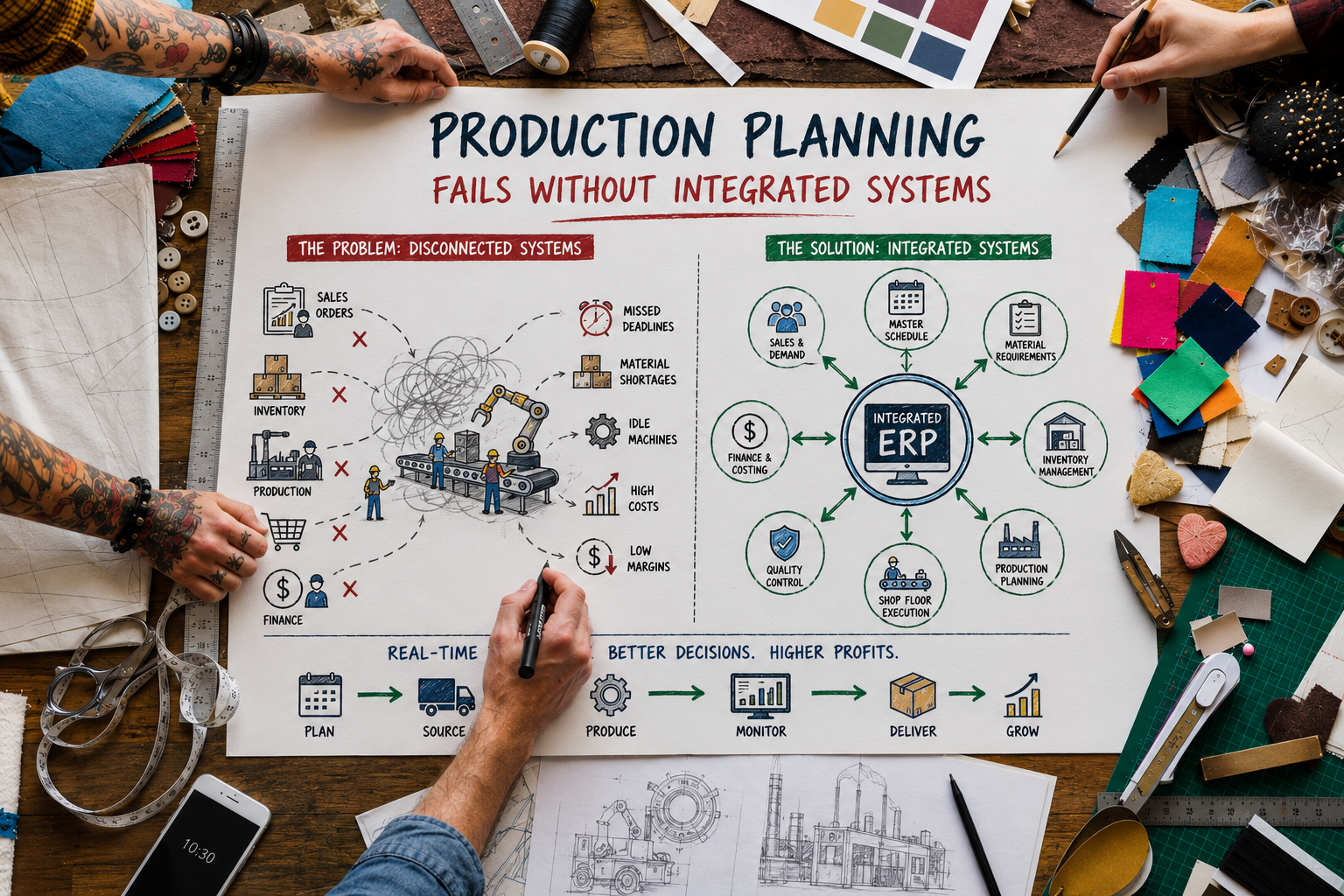

Production planning sits at the center of manufacturing performance. It determines how efficiently raw materials are converted into finished goods, how well resources are utilized, and whether customer commitments are met on time. Yet despite its importance, many factories continue to struggle with recurring delays, stock shortages, production bottlenecks, and inconsistent output.
In most cases, these issues are not caused by poor planning teams. They are caused by poor planning environments.
Factories operating without integrated ERP systems often manage production planning through a mix of spreadsheets, disconnected software, manual reports, and departmental coordination. While this may appear manageable at smaller scales, the model begins to break as operations grow more complex. The result is a planning process built on delayed information, fragmented visibility, and operational assumptions rather than live data.
An integrated ERP system addresses this by connecting production planning with inventory, procurement, costing, and shop floor operations, turning planning from a reactive task into a data-driven operational function.
Production Planning Depends on More Than Scheduling

Many organizations view production planning as simply deciding what to produce and when. In reality, effective planning depends on multiple operational variables being continuously aligned.
A production plan is only accurate if the planner knows the true availability of raw materials, understands current machine capacity, has visibility into procurement lead times, can account for work-in-progress, and can trust that previous production data reflects operational reality.
When these inputs are disconnected, even experienced planners are forced to make decisions using assumptions rather than facts.
This is where planning begins to fail.
The Inventory Visibility Problem

One of the most common reasons production schedules collapse is inaccurate inventory data.
A planner may schedule a production run based on system records showing raw material availability, only for the shop floor to discover that stock is unavailable, already reserved, partially consumed, or inaccurately recorded. In environments where inventory and production systems are disconnected, these mismatches are common.
The result is immediate disruption. Machines remain idle, schedules are pushed back, procurement teams rush emergency orders, and delivery timelines begin slipping.
Integrated ERP systems solve this by linking inventory movements directly with production and procurement activity, ensuring planners work from real-time stock data rather than static reports.
Procurement Delays Create Hidden Planning Risks
Production planning cannot succeed if procurement operates independently.
In many factories, purchasing teams receive material requirements through manual communication after production plans are already created. This delay introduces procurement lag, increases supplier coordination issues, and creates blind spots around incoming material timelines.
By the time procurement identifies shortages, production schedules have already been committed.
Integrated ERP systems eliminate this disconnect by automatically generating procurement requirements from production plans and current stock levels. This ensures purchasing decisions happen in sync with planning instead of after the fact.
For manufacturers managing multiple suppliers or long lead-time materials, this synchronization becomes critical.
Static Planning Cannot Handle Dynamic Operations
Manufacturing environments change constantly. Machine breakdowns occur unexpectedly. Urgent customer orders arrive mid-cycle. Labor availability shifts. Material quality issues create rework. Priorities change throughout the day.
Spreadsheet-based planning models are not designed for this level of operational fluidity.
When planning tools cannot adjust dynamically, planners spend more time revising schedules than optimizing them. And because manual updates are slow, the shop floor often operates on outdated instructions.
Integrated ERP systems provide dynamic scheduling capabilities, allowing planners to update production sequences, resource allocation, and work orders in real time based on actual operating conditions.
Planning Fails When There Is No Shop Floor Feedback Loop
A production plan is only as valuable as the factory’s ability to execute against it.
Many manufacturers lack real-time visibility into what is actually happening on the shop floor once production begins. Planners cannot see whether jobs are ahead of schedule, behind schedule, delayed at a specific process, or consuming more material than expected.
Without this execution feedback, future planning becomes disconnected from operational reality.
Integrated ERP closes this loop by feeding live production data back into the planning process. Work order status, output progress, machine utilization, and process delays become visible in real time, allowing planning teams to adjust proactively rather than reactively.
Costing Errors Distort Planning Decisions
Another overlooked cause of production planning failure is inaccurate manufacturing costing.
When manufacturers cannot track true production costs at the order, batch, or product level, they struggle to prioritize the right jobs, estimate realistic margins, or understand where operational inefficiencies exist.
A factory may continue prioritizing high-volume orders believing they are profitable, while hidden material losses, labor inefficiencies, or machine overutilization quietly erode margins.
Integrated ERP systems connect production activity with costing data, giving management visibility into actual versus planned consumption, labor utilization, waste, and profitability.
According to Oracle, manufacturers with integrated operational and financial systems gain significantly better forecasting and profitability control because planning decisions are grounded in real cost data rather than estimates.
The Cost of Poor Production Planning Compounds Over Time
Production planning inefficiencies rarely remain isolated.
A delayed production schedule affects inventory turnover. Inventory issues disrupt procurement. Procurement delays impact customer delivery timelines. Delivery failures reduce client trust. Overtime increases labor cost. Emergency purchasing raises procurement expense. Margin pressure builds quietly across the operation.
What begins as a planning issue often becomes an organization-wide performance problem.
Over time, factories operating this way struggle to scale because operational complexity grows faster than management visibility.
How Integrated ERP Restores Planning Control
An integrated ERP system brings structure and synchronization to manufacturing planning by centralizing operational data into a single environment.
Rather than relying on departmental updates and static spreadsheets, planners gain live access to the data they need to make informed decisions. Inventory availability, procurement status, work-in-progress, machine utilization, and costing data all become part of the same planning ecosystem.
This allows production plans to reflect operational reality, not assumptions.
For manufacturers, the impact is substantial: more reliable scheduling, fewer disruptions, improved resource utilization, stronger delivery performance, and better cost control.
Manufacturers looking to digitize these workflows can explore the full manufacturing capabilities of Xenon ERP at https://atxenon.com/manufacturing-solution/
Conclusion
Production planning failures are rarely caused by a lack of expertise. More often, they occur because factories are attempting to manage increasingly complex operations with disconnected tools and fragmented information.
As manufacturing environments become more demanding, planning requires more than scheduling capability, it requires operational visibility, synchronized data, and real-time responsiveness.
Integrated ERP systems provide that foundation.
Factories that continue planning without integration often find themselves trapped in a cycle of delays, firefighting, and shrinking margins. Those that adopt integrated production planning systems gain the control needed to operate efficiently and scale confidently.
FAQs
Why does production planning fail in manufacturing?
Production planning often fails because planners lack real-time visibility into inventory, procurement, machine capacity, and shop floor execution.
How does ERP improve production planning?
ERP improves production planning by integrating inventory, procurement, scheduling, costing, and production tracking into one centralized system.
Can ERP reduce production delays?
Yes. ERP helps reduce delays by improving planning accuracy, identifying shortages early, and enabling dynamic schedule adjustments.
Why are spreadsheets ineffective for factory planning?
Spreadsheets cannot provide live synchronization across departments or adapt efficiently to real-time operational changes.
Is ERP useful for textile and process manufacturers?
Yes. ERP is particularly valuable in textile and process manufacturing where material flow, costing, and multi-stage production complexity are high.
Optimize Production Planning With Xenon ERP
If your manufacturing operation is still relying on spreadsheets, disconnected systems, or manual coordination for production planning, the limitations will compound as your business grows.
Xenon ERP helps manufacturers integrate production planning, inventory, procurement, and costing into one unified system, enabling smarter scheduling, better visibility, and stronger operational control.
Learn More: https://atxenon.com/