
Most businesses in Pakistan do not fail at ERP because the software was bad. They fail because they never asked the right questions before signing the contract. A slick demo and a good discount are not enough to judge if a system will actually work for your business.
Buying ERP software is a long term commitment. You are not just buying a tool, you are choosing a partner who will touch your finances, your inventory, your payroll, and your compliance for years to come. Get it wrong and you end up with an expensive system nobody in your office wants to use.
This guide walks you through the 9 questions every Pakistani business owner, finance manager, or operations manager should ask before buying ERP software. Ask these before you sign anything, and you will save yourself months of frustration and a lot of money.
Why Most Pakistani Businesses Get ERP Buying Wrong

Many SME founders choose ERP software the same way they choose a printer. They compare prices, pick the cheapest or the most familiar name, and move on. The problem is ERP touches every part of your operations, so a wrong choice affects sales, stock, tax filing, and staff salaries all at once.
At Xenon, we have worked with over 50 businesses across Pakistan, and the pattern is always the same. The companies that struggle are the ones who never asked about implementation, support, or long term fit before signing. The companies that succeed asked hard questions early.
Question 1: Does This ERP Actually Fit My Industry, or Is It Generic?
A generic ERP built for no one in particular usually ends up needing heavy customization later, which costs more time and money. Ask the vendor directly if they have built modules for your industry, whether that is textile manufacturing, retail chains, or distribution businesses.
Ask for examples. A vendor who has handled inventory management for a Sialkot exporter or point of sale for a Lahore retail chain will understand your workflow faster than one starting from scratch.
Question 2: What Does Implementation Actually Include?
Implementation means different things to different vendors. Some just install software and hand you a manual. Others handle data migration, staff training, and testing before go live.
Ask exactly what is included in ERP implementation: data migration from your current system, custom report setup, user training sessions, and a testing period before you switch over fully. Get this in writing, not just spoken during the sales call.
Question 3: How Long Will Implementation Really Take?
Vendors often quote the best case timeline to close the deal faster. A real implementation for a mid sized business usually takes 6 to 12 weeks, sometimes longer for multi location businesses or complex inventory setups.
Ask for a realistic timeline based on a similar business, not a generic estimate. And ask what could delay it, since delays usually come from incomplete data on your end or scope changes mid project.
Question 4: Is FBR and Tax Compliance Built In, or Bolted On?
This is a big one for Pakistani businesses. FBR sales tax rules, digital invoicing requirements, and SECP filings change often, and your ERP system needs to keep up without you manually adjusting formulas every quarter.
Ask if compliance updates are automatic or if you will be charged separately every time a tax rule changes. A system with the right financial module and FBR digital invoicing integration built in saves your finance team hours every month.
Question 5: What Happens After Go Live? What Does Support Look Like?
The real test of an ERP vendor starts after implementation, not before. Ask what support looks like once you are live: is it same day response, next day, or does it disappear into a ticket queue for a week?
Ask if support is based in Pakistan or overseas, since time zone gaps slow down urgent fixes. A vendor who genuinely works with Pakistani business owners day to day will understand your urgency better than a support desk in another country.
Question 6: Can the System Grow With My Business?
What works for 20 employees today might not work for 100 employees in three years. Ask if you can add users, warehouses, or modules like HR and Payroll later without rebuilding the system from scratch.
Also ask about pricing at scale. Some vendors charge low per user costs early and raise them sharply once you cross a certain number of users or locations. Our HR and Payroll module is priced to grow with your headcount instead of punishing you for it.
What to Look For vs What Vendors Often Offer
Here is a quick side by side of what actually matters when comparing ERP vendors in Pakistan.
| What to Look For | Why It Matters | What Xenon Offers |
| Industry specific modules | Avoids costly customization later on | Built for textile, retail, and distribution businesses |
| Transparent implementation plan | Prevents scope creep and delays | Data migration, training, and testing included upfront |
| FBR compliance built in | Saves manual tax work every quarter | Digital invoicing and sales tax updates included |
| Local support team | Faster fixes, no time zone gap | Same day response across Pakistan |
| Clear exit terms | Protects your data and flexibility | Full data export, no lock in |
Question 7: What Is the Real Total Cost, Not Just the License Price?
The license or subscription fee is rarely the full picture. Ask about setup fees, training costs, customization charges, hosting fees, and what happens when your annual support contract renews.
A detailed cost assessment before you sign protects you from surprise invoices six months in. If a vendor is reluctant to break down costs clearly, treat that as a warning sign. You can get in touch with our team for a transparent breakdown before you commit to anything.
Question 8: Can I Talk to an Existing Client in Pakistan?
Case studies on a website are easy to write. A real conversation with an existing client is not. Ask the vendor to connect you with a business similar to yours, ideally in the same industry or city.
A vendor with a genuine track record across Pakistan will have references ready. If they hesitate or only offer international case studies, that tells you something about their local experience.
Question 9: What Data Ownership and Exit Terms Do I Get?
Your business data, sales records, inventory history, and customer information belong to you, not the vendor. Ask what happens if you ever want to switch systems. Can you export your data fully and easily?
Some vendors make it deliberately difficult to leave. Ask about exit terms before you sign, not after you are already locked in.
Quick Checklist: Questions to Ask Before You Sign
Save or screenshot this list before your next vendor call.
| # | Question to Ask Your ERP Vendor |
| 1 | Does this ERP actually fit my industry, or is it generic? |
| 2 | What does implementation actually include? |
| 3 | How long will implementation really take? |
| 4 | Is FBR and tax compliance built in, or bolted on? |
| 5 | What happens after go live? What does support look like? |
| 6 | Can the system grow with my business? |
| 7 | What is the real total cost, not just the license price? |
| 8 | Can I talk to an existing client in Pakistan? |
| 9 | What data ownership and exit terms do I get? |
Why Pakistani Businesses Choose Xenon
Xenon was built specifically for the Pakistan SME sector, not adapted from a global template. Our team has worked with textile exporters, retail chains, and distribution businesses across Karachi, Lahore, Faisalabad, and Sialkot, so we understand the operational and compliance challenges you face.
We handle full implementation, from data migration to staff training, and our support team responds same day because we are based here, not overseas. FBR digital invoicing and sales tax compliance are built into the system, not sold as a separate add on.
If you want a detailed cost assessment or just want to see how Xenon fits your specific business, book a free demo and let us help you map out your ERP rollout.
Frequently Asked Questions
How much does ERP software cost in Pakistan?
Costs usually range from Rs. 3 Lakh to Rs. 15 Lakh depending on business size, number of users, and modules needed. Get a detailed cost assessment based on your specific requirements rather than relying on a general price range.
How long does ERP implementation take for a small business?
For most small and mid sized businesses in Pakistan, implementation takes 6 to 12 weeks. Multi location businesses or complex inventory setups can take longer.
Is ERP software worth it for a small business in Pakistan?
Yes, if manual processes like Excel tracking, disconnected systems, or FBR compliance are already costing you time and errors. Smaller businesses often see the fastest return since manual work eats up a larger share of their operations.
Does ERP software in Pakistan include FBR compliance?
It depends on the vendor. Some include FBR digital invoicing and sales tax compliance as a core feature, while others charge separately or leave it out entirely. Always confirm this before signing.
Can I switch ERP vendors if I am not happy with the current one?
Yes, but it depends on your data ownership and exit terms. Ask about this before you sign your first contract, since some vendors make data export difficult on purpose.
What industries in Pakistan use ERP software the most?
Textile and apparel manufacturing, retail chains, and distribution businesses are among the heaviest ERP users in Pakistan, largely due to inventory complexity and compliance requirements.
Do I need separate software for HR and Payroll, or is it part of ERP?
Most modern ERP systems, including Xenon, include HR and Payroll as a module. This means employee records, attendance, and salary processing run on the same system as your finance and inventory data.
What is the difference between ERP and accounting software?
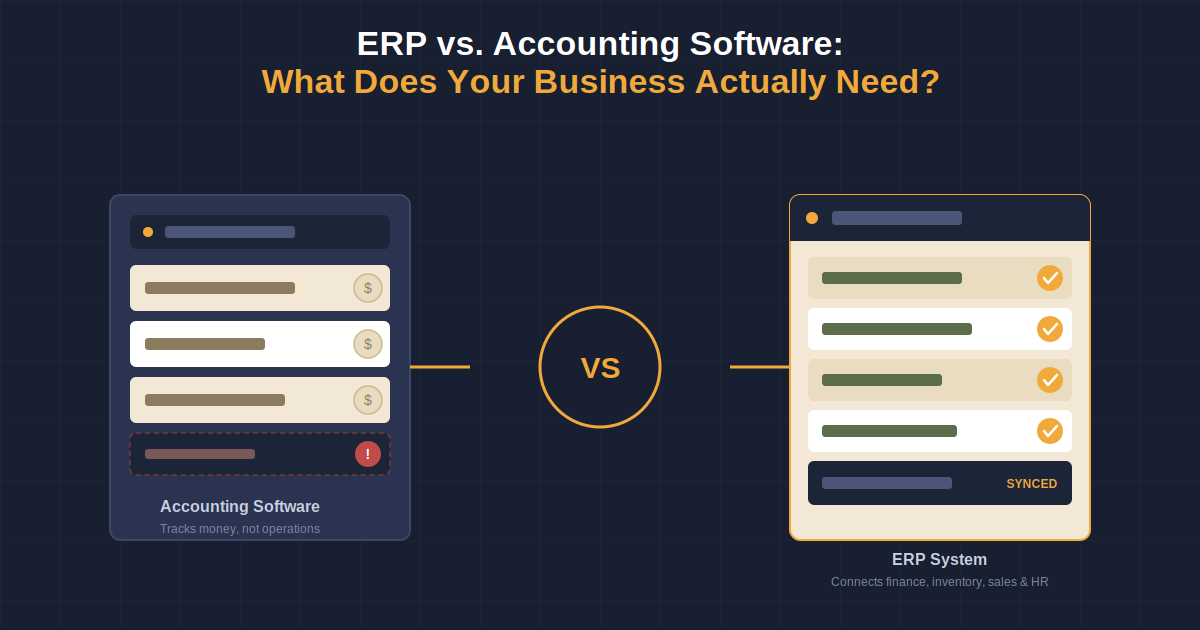
Accounting software handles your books. ERP software connects your finances with inventory, sales, HR, and compliance in one system, giving you a full operational view instead of just financial reports.
How do I know if my business is ready for ERP software?
If you are managing inventory, sales, or compliance across multiple spreadsheets or disconnected tools, and it is costing you time or causing errors, you are likely ready. Business size matters less than operational complexity.
Final Thoughts
Buying ERP software in Pakistan is a big decision, and the vendor who talks the fastest is not always the one who delivers the best system. Ask these 9 questions before you sign anything, and you will avoid the mistakes that trip up most Pakistani SMEs.
If you want to go deeper, check out our guides on ERP Software Cost in Pakistan: Complete Breakdown for SMEs.
Ready to see how Xenon fits your business? Book a free demo or get in touch with our team for a detailed cost assessment.