The factory floor is an intricate environment where success depends on precise synchronization. To keep a manufacturing operation running smoothly, multiple variables must align perfectly: raw materials must arrive exactly when needed, machinery must operate at peak capacity, labor shifts must match production demands, and delivery schedules must coordinate with logistics providers.
When these moving parts work together seamlessly, production moves efficiently, profit margins remain stable, and delivery deadlines are consistently met. However, in many manufacturing enterprises, this ideal state is regularly disrupted by unexpected bottlenecks, unexplainable material shortages, idle assembly lines, and missed shipment deadlines.
Many manufacturing executives treat these disruptions as normal operational challenges, unavoidable issues that come with running a complex industrial business. But when you look closer, these persistent production failures are rarely caused by a lack of effort from floor managers or mechanical breakdowns. Instead, they are the direct result of a fractured software foundation. Production planning is fundamentally destined to fail when it relies on isolated data silos, manual data entry, and disconnected business systems.
The Core Friction: Operating Production in a Vacuum
The primary reason isolated production planning systems fail is that manufacturing does not happen in a vacuum. It is a highly connected process that links raw procurement metrics directly to customer delivery deadlines.
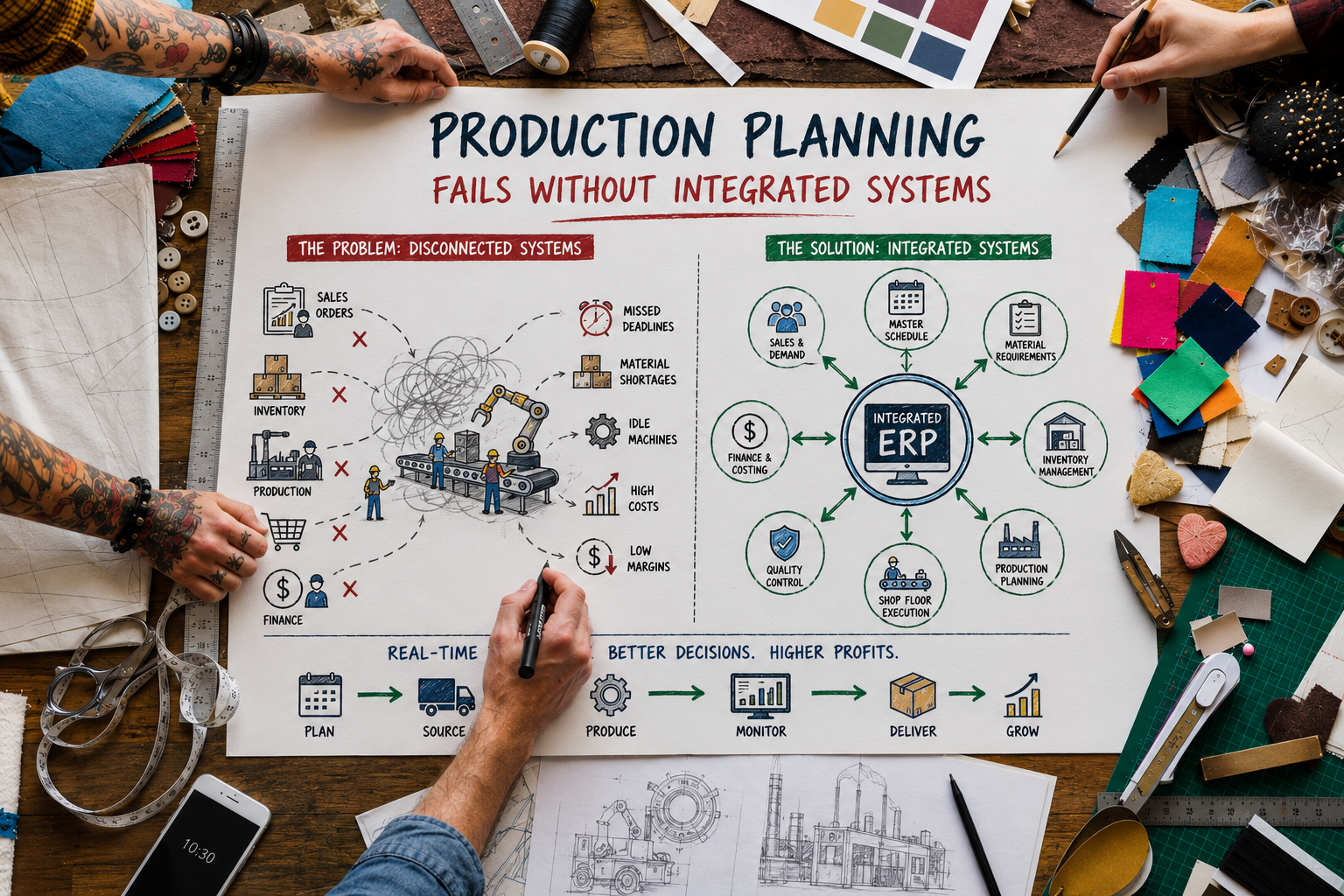
When a manufacturing facility runs its production schedule on a standalone system, such as a specialized application or a collection of complex, manually updated spreadsheets, that system remains completely cut off from the rest of the business. This lack of connection creates structural gaps across three critical business touchpoints:
1. The Disconnect Between Sales Demand and Live Floor Capacity
In an unintegrated environment, the sales team and the production planning team operate in entirely different worlds. The sales department actively signs custom client agreements and locks in delivery dates based on historical assumptions or generalized timelines.
Meanwhile, the production planning team might be dealing with unexpected machine maintenance, unannounced labor shortages, or a sudden backlog of internal orders. Without a live, bi-directional data bridge connecting front-end customer pipelines to back-end floor schedules, sales teams routinely promise delivery dates that the factory cannot physically meet. This structural gap leads directly to rushed operations, expensive expedited shipping fees, and frustrated clients.
2. The Material Blind Spot and Phantom Inventory
A production plan is only as good as the raw materials available to execute it. When production planning software does not communicate directly with warehouse management systems, planners must build schedules based on static, snapshot inventory reports.
This lack of visibility leads to two frustrating operational issues:
- The Procurement Delay: A production run for a high-priority order is scheduled to begin on a Monday morning. The team unboxes the materials, only to discover that a critical sub-component is missing or was accidentally allocated to a different job. The line stops, workers sit idle, and the timeline slips while procurement scrambles to place an emergency order.
- The Capital Glut: To protect themselves from unexpected shortages, planners default to over-ordering raw materials. This defensive buying keeps significant working capital trapped on warehouse shelves in the form of excess safety stock, driving up material carrying costs and reducing corporate cash flow.
3. The Lack of Real-Time Job Costing and Margin Erosion
When production systems are disconnected from core financial accounting ledgers, calculating the true cost of a production run becomes a slow, retrospective guessing game. Floor managers track raw material waste, machine uptime, and labor hours on paper logs or isolated local drives.
By the time the accounting department collects, manual cleans, and reconciles this data at the end of the month, the damage is already done. If a specific production line suffered from major material waste or required extensive overtime to hit a deadline, that job may have completely erased its expected profit margins. Without instant financial feedback loops, management cannot identify and fix these profit leaks until long after the product has shipped.
The Strategic Shift: Linking Shop Floor Operations to Business Intelligence
Overcoming the failures of legacy production scheduling requires a fundamental change in how manufacturing data is handled. True operational efficiency is achieved when your manufacturing processes are deeply woven into your wider enterprise management infrastructure.
Connecting Manufacturing Data directly to Financial Registers
Every turn of a machine gear and every ounce of raw material processed represents real corporate capital. In historical management setups, tracking material depreciation, work-in-progress (WIP) valuations, and final cost of goods sold (COGS) requires intensive manual accounting adjustments.
Integrating your production floor directly with your core financial operations ensures that every material issues log and completed assembly step updates your financial records instantly. This clear connection gives your executive leadership team a real-time view of actual job profitability. To learn more about setting up these unified corporate frameworks, check out this comprehensive guide on Modern Finance & Accounting Architecture.
Syncing Material Requirements with Complex Project Timelines
For industrial manufacturers, engineers-to-order businesses, and project-driven organizations, a production delay can cause a cascade of problems that stalls multi-million dollar contracts. If a tailored component isn’t fabricated and verified on time, field installation teams sit idle at the client site, driving up labor overhead and triggering steep contractual penalties.
Linking your material requirements planning (MRP) and shop floor scheduling directly into your project management modules guarantees that active production runs are always aligned with live project demands. For an in-depth breakdown of managing resource, labor, and material allocation across project-driven operations, review our detailed guide on Maximizing Margins via Project Accounting.
Outside of internal workflows, integrating your manufacturing engine with global logistics providers, automated vendor networks, and external electronic data interchange (EDI) hubs ensures your supply chain stays agile, resilient, and highly scalable.
Breaking Down the Technical Silos That Cripple Production
To understand why unintegrated production planning fails so consistently, it is essential to trace the exact path that information takes or fails to take across a disconnected enterprise. When software modules cannot speak the same language, the resulting operational gaps reveal themselves in specific, costly ways on a daily basis.
The Problem of Static Master Production Schedules (MPS)
In a siloed manufacturing plant, the Master Production Schedule is typically generated once a week or once a month. This schedule is based on a static snapshot of what resources were available at that specific moment in time.
However, a modern manufacturing floor changes by the minute. A machine component failure on line two or a delayed raw material shipment instantly makes a static schedule obsolete. Because the planning software cannot automatically recalculate dependencies across the entire organization, floor managers are forced to manually adjust schedules using physical dry-erase boards or local spreadsheets. This creates a dangerous information gap where the front office believes one plan is executing while the floor is actively running another.
Inventory Inaccuracies and Material Disconnects
Without direct, two-way communication between Material Requirements Planning (MRP) modules and the active warehouse floor, inventory numbers degrade rapidly. Inventory changes aren’t just driven by sales; they are heavily altered by scrap rates, quality control rejections, and engineering changes.
If your quality assurance team rejects a defective batch of raw materials but that rejection isn’t instantly updated in the production planning ledger, the scheduling engine will continue to build dependencies around components that cannot legally be used. When the production line finally calls for those parts, the line stalls completely while a team investigates why the digital records do not match physical availability.
Human Capital and Capacity Misallocations
Production lines do not run on materials alone; they require a highly synchronized allocation of skilled labor. In an unintegrated setup, employee scheduling data lives entirely within an isolated Human Resource Management system or basic timekeeping application.
When a production planner maps out a complex multi-stage assembly job, the scheduling tool has no baseline visibility into specialized operator availability, active vacation requests, or overtime caps. Jobs are frequently scheduled under the assumption of full capacity, only for operations to slow down because the one certified technician required to operate a specific piece of machinery is away on scheduled leave.
The Core Advantages of a Unified Production Environment
Transitioning from siloed legacy tools to a fully integrated enterprise architecture transforms how a manufacturing business functions on a day-to-day basis.
- Dynamic, Data-Driven Scheduling: Planners can confidently build production schedules backed by real-time inventory counts, verified machine availability metrics, and current labor capacity.
- Automated Material Allocation: The moment an order is confirmed, the system automatically checks current stock, allocates required materials to that job, and triggers automated purchase requisitions for any shortfalls.
- True Traceability: From the raw material receiving dock all the way through quality assurance testing and final customer fulfillment, every step of the journey is logged digitally under a single reference code.
- Agility in Supply Chain Disruptions: When external shipping bottlenecks occur, an integrated system allows logistics coordinators to instantly assess substitute materials across alternative facilities, preventing a localized delay from turning into a plant-wide shutdown.
Run Your Production Engine on a Single Platform
Managing multiple disconnected software tools, dealing with fragile data integrations, and spending hours manually matching spreadsheets slows down your company’s growth. To run an efficient, highly scalable manufacturing operation, you need a central platform where every single module communicates naturally.
XENON All-in-One ERP delivers the end-to-end visibility, automated material coordination, and real-time processing power required to run your manufacturing enterprise with absolute confidence. By blending material requirements planning (MRP), live shop floor scheduling, client invoicing, and core financial accounting into one unified ecosystem, XENON entirely removes human error and data silos from your daily operations.
Ready to eliminate production bottlenecks, protect your job margins, and streamline your supply chain? Visit ATXENON to explore our advanced Manufacturing & Production Management module and schedule your tailored live demo today.