
If your business still runs on Excel sheets, paper registers, and WhatsApp updates between branches, you already know the real cost. It is not just the wasted hours. It is the stock count that never quite matches, the payroll that takes three days every month, and the sales tax filing that turns into a scramble at the last minute.
Most business owners in Karachi, Lahore, and Faisalabad do not switch to ERP because someone told them to. They switch because a spreadsheet finally broke something that mattered, a missed reorder, a payroll error, an FBR deadline nearly missed.
This breakdown looks at what actually changes when a Pakistani business moves off manual systems and onto Xenon. Not vague promises. Real areas where time, money, and stress go down, based on what businesses using Xenon report today.
By the end, you will know exactly where your business is bleeding time on manual work, and what switching realistically looks like.
The Real Cost of Running Your Business on Excel
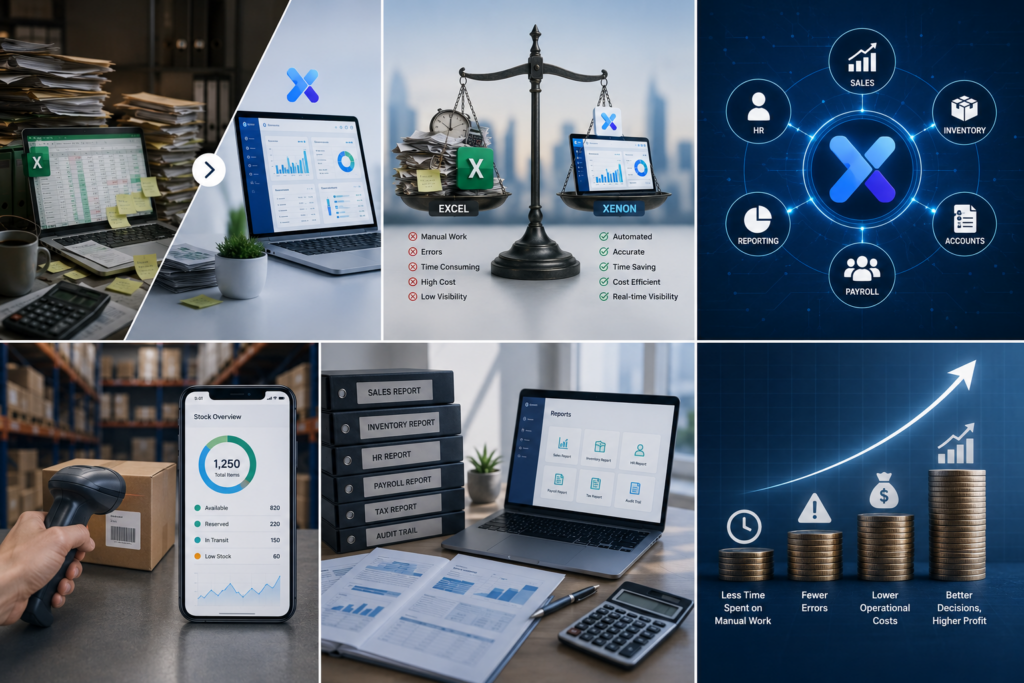
Excel was never built to run a business. It was built to calculate numbers in a single sheet. The moment you connect sales, inventory, payroll, and accounts, spreadsheets start cracking at the seams.
Every extra branch, every new employee, every added product line means another tab, another formula that might break, another version of the file floating around on someone’s laptop. Business owners rarely notice this cost directly. It shows up instead as late nights, mismatched numbers, and decisions made on outdated information.
The businesses we talk to across Karachi’s retail, distribution, and manufacturing sectors describe the same pattern: things worked fine with five employees and one location. At fifteen employees and three locations, the cracks become impossible to ignore.
Where Manual Systems Quietly Eat Into Your Week
Ask any business owner running manual systems how many hours a week go into reconciling numbers, chasing updates from branches, or double checking a spreadsheet formula, and the number is usually higher than they expect.
- Re entering the same sale into a register, then a spreadsheet, then a WhatsApp group for the owner
- Calling branch managers for stock updates instead of seeing them on a screen
- Rebuilding reports from scratch every month because the format keeps drifting
- Fixing broken formulas after someone accidentally overwrites a cell
None of this shows up as a single big cost. It shows up as a business owner who is always busy but never quite caught up.
Common Errors That Cost Pakistani Businesses Money
Manual data entry has a built in error rate. A finance manager typing the same invoice into two systems will eventually enter the wrong number in one of them. A stock clerk counting cartons by hand will eventually miscount.
These errors are small individually. Over a year, they add up to overselling stock that was not actually available, paying a supplier twice for the same delivery, or under reporting sales tax because a transaction never made it into the spreadsheet. None of these are dramatic on their own. Together, they quietly cost real money.
The Hidden Price of Manual Inventory Tracking
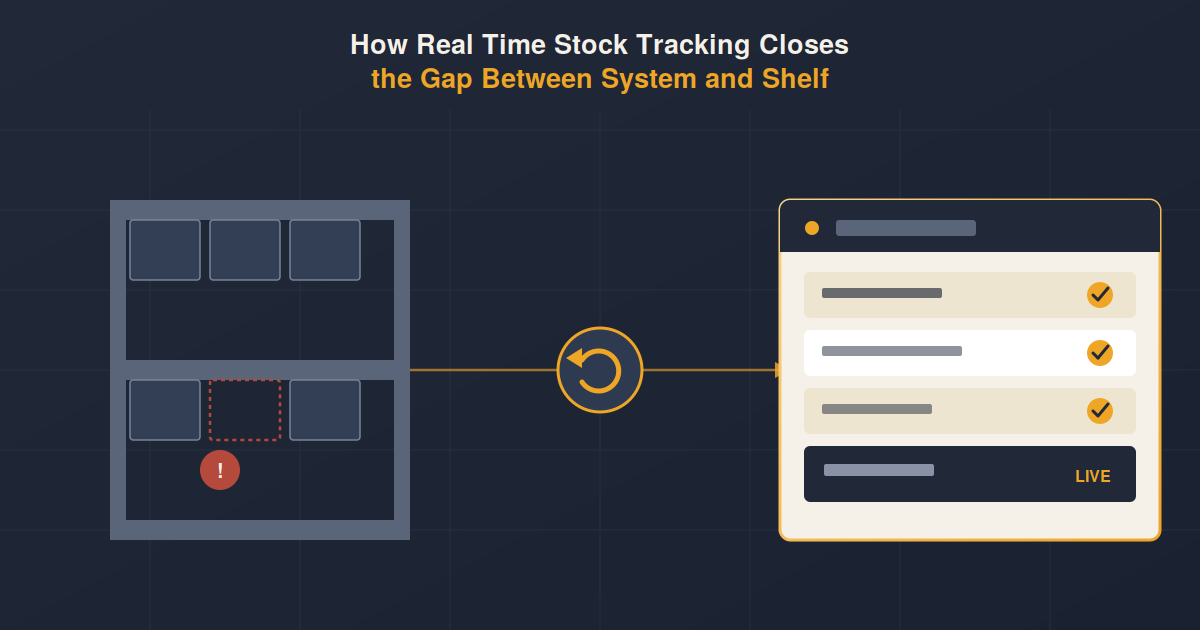
Inventory is where manual systems fail most visibly. A spreadsheet can tell you how much stock you had last time someone updated it. It cannot tell you what is actually on the shelf right now, at this branch, in this batch.
This is the gap that leads to overstocking one warehouse while another runs out, or discovering a shortage only when a customer asks for something you thought you had. Businesses running serial wise and batch wise tracking through an ERP describe a different experience entirely, complete unit level visibility, accurate valuation, and full confidence during audits and compliance reporting.
Payroll and HR: What Manual Processes Really Cost You
Manual payroll usually means a spreadsheet, a stack of attendance sheets, and a finance manager doing calculations by hand every month end. It is slow, and it is where errors are the most sensitive, since a mistake in someone’s salary or leave balance affects trust directly.
Leave management adds another layer. Without a centralized system, approvals happen over chat messages, balances get miscounted, and employees are often unsure how many days they actually have left. Businesses that have automated this describe it simply: leave approvals are faster, balances are accurate, and managers finally have real time visibility to plan their teams properly.
Manual Bookkeeping vs Automated Accounting: A Side by Side Look
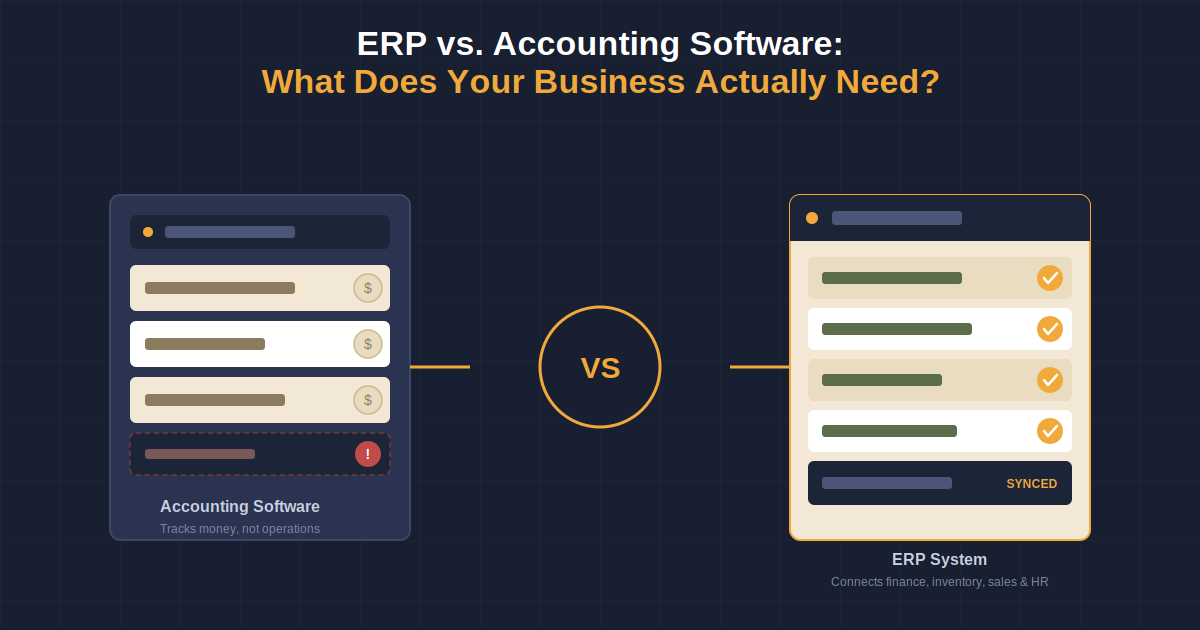
The clearest way to see the difference is to place manual processes and an integrated ERP side by side across the tasks that matter most day to day.
| Task | Excel or Manual System | Xenon ERP |
| Recording a sale | Typed in manually, often twice (register plus spreadsheet) | Entered once, updates inventory and accounts automatically |
| Monthly reconciliation | 2 to 4 days of manual cross checking | Reports generate in minutes |
| Stock counts | Physical counts, guesswork on shortages | Real time stock levels, serial and batch level detail |
| Payroll processing | Manual attendance sheets, calculator, error prone | Automated, tied to attendance and leave records |
| FBR sales tax prep | Manual data pulling, risk of missed entries | Structured records ready for filing |
| Multi branch visibility | Phone calls and WhatsApp updates | One dashboard, real time across branches |
| Audit readiness | Scrambling to find and match paper trails | Serial wise traceability, ready on demand |
The pattern across every row is the same. Manual systems require a person to hold everything together in their head. An ERP holds it together automatically, and frees that person to actually run the business instead of maintaining the paperwork behind it.
What Serial Wise Inventory Tracking Actually Saves You
Serial wise tracking sounds like a technical detail until you are the one trying to explain a stock discrepancy to an auditor. With unit level traceability, every item can be traced from purchase to sale, which means audit season stops being a scramble through old invoices.
Businesses using this level of tracking through Xenon report end to end serial traceability, accurate unit level valuation, and full confidence in audit and compliance reporting, the kind of clarity that simply is not possible with a spreadsheet, no matter how carefully it is maintained.
Carton Wise Dispatch: Less Reconciliation, Fewer Mistakes
For distribution and warehouse operations, dispatch accuracy is where manual systems create the most friction. Matching what left the warehouse against what was invoiced, by hand, is tedious and error prone work.
Carton wise dispatch tracking changes that. Warehouse operations become significantly smoother, dispatch accuracy improves, manual effort drops, and reconciliation between inventory and invoicing becomes seamless rather than a monthly headache.
FBR Compliance: Why Manual Record Keeping Is a Growing Risk
Pakistan’s tax reporting requirements have gotten stricter, not looser. Sales tax filing, digital invoicing expectations, and audit scrutiny all depend on records that are accurate and easy to produce on demand.
A spreadsheet that is missing a transaction, or a stock figure that does not match what was actually sold, is not just an internal headache anymore. It is a compliance risk. Structured, automated record keeping through an ERP removes the guesswork and keeps your numbers ready whenever FBR or an auditor asks for them.
If your business is still reconciling sales tax data by hand every month, it may be worth a quick conversation about how much of that risk an integrated system would remove.
Real Numbers: Time and Cost Businesses Report After Switching
Every business is different, and exact savings depend on size, industry, and how manual the previous system was. That said, a consistent pattern shows up across businesses that move from spreadsheets to an integrated ERP like Xenon.
- Month end reconciliation that used to take days often drops to hours
- Payroll processing time falls significantly once attendance and leave feed directly into payslips
- Stock discrepancies during audits become rare instead of routine
- Dispatch and invoicing reconciliation stops being a separate monthly task
The value is not just time. It is the reduced risk of the kind of mistake that costs real money, an overstock, a missed reorder, a payroll error, or a compliance gap. If you want a clearer picture of what this could look like for your specific setup, a detailed cost assessment is a good place to start.
Distribution, Retail, and Manufacturing: Different Businesses, Same Savings
A distributor running multiple warehouses across Karachi and Lahore struggles most with dispatch accuracy and stock visibility across locations. A retail chain feels the pain most in daily reconciliation and multi branch reporting. A manufacturer feels it in production tracking and raw material valuation.
The specific pain point differs, but the underlying problem is the same: manual systems cannot keep pace once a business has more than one location, more than a handful of employees, or more than a simple product line. An integrated ERP solves the same core problem across all three, visibility and accuracy, from a single platform.
Excel vs Xenon: What Actually Changes Day to Day
It helps to picture an ordinary Tuesday. On Excel, a branch manager texts the day’s sales figures, someone manually updates a master sheet, and stock levels are only as current as the last time someone remembered to check.
On Xenon, that same Tuesday looks different. Sales, inventory, and accounts update automatically as transactions happen. The owner can see real time numbers across every branch from one dashboard, without a single phone call or WhatsApp message. That shift, from chasing information to simply seeing it, is where most of the time savings actually come from.
What Switching Actually Looks Like, Step by Step
Business owners often assume switching from manual systems means weeks of disruption. In practice, a structured rollout keeps operations running while the new system comes online.
- Initial assessment of current processes and pain points
- Data migration from existing spreadsheets and records
- Module setup tailored to your business, inventory, accounting, HR and payroll, sales
- Team training so staff are comfortable before full rollout
- Parallel run alongside the old system to confirm accuracy
- Full go live with ongoing support
Most Pakistani businesses that go through this process describe the first month as the biggest adjustment, and the months after as the moment they realize how much time they used to lose without noticing.
Questions to Ask Before You Move Off Manual Systems
Before making the switch, it is worth being clear on a few things so the transition is smooth rather than stressful.
- Which modules does your business actually need right now, versus later
- How much historical data needs to move into the new system
- Who on your team will own the transition internally
- What does support look like after go live, not just during setup
- How does the system handle FBR and local compliance requirements specifically
A team that has implemented ERP systems for businesses across Pakistan’s textile, distribution, and services sectors can usually answer these in a single conversation, and map out a rollout that fits your specific operations rather than a generic template.
Why Pakistani Businesses Are Choosing Xenon
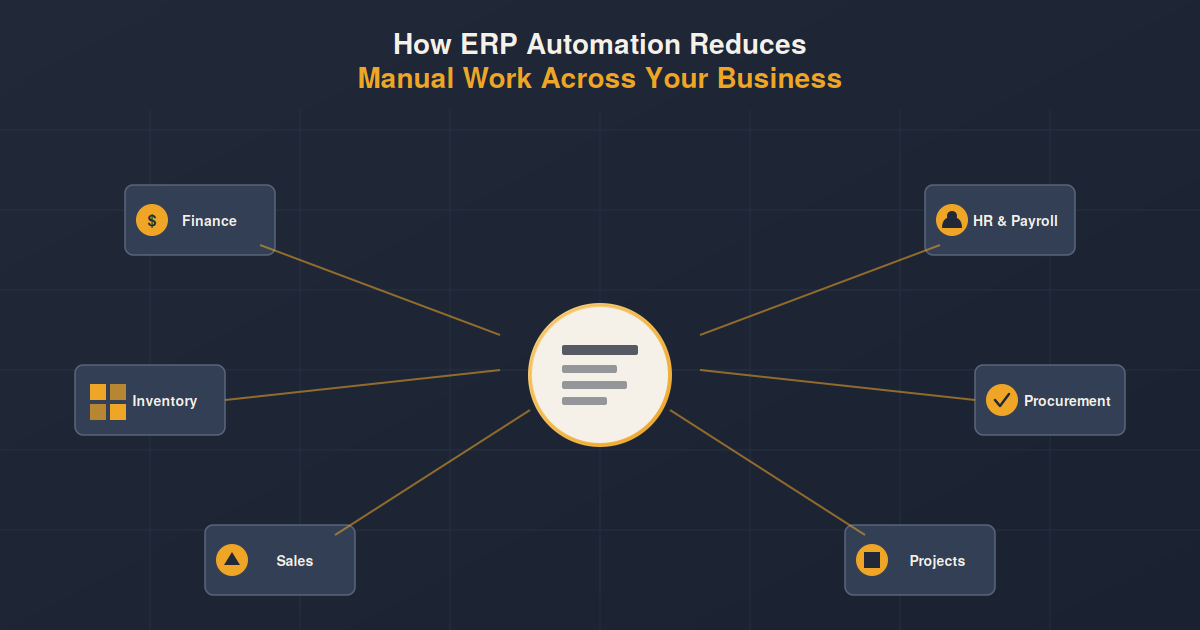
Xenon was built as a SaaS powered suite of business applications for SMEs, covering accounting, HRM and payroll, sales, inventory, and procurement in one connected platform. It is designed specifically for businesses that have outgrown spreadsheets but do not need, or want to pay for, an enterprise system built for multinational corporations.
Clients using Xenon consistently point to the same outcomes: transparent operations, accurate real time data, and compliance that does not require weeks of manual preparation before an audit. For businesses across Karachi, Lahore, Faisalabad, and Sialkot managing everything from retail counters to multi branch distribution, that combination of affordability and depth is the reason the switch makes sense.
If manual systems have started costing you more time than they save, book a free demo and see what Xenon looks like running your actual operations.
Final Thoughts
The cost of manual systems rarely shows up as one big number. It shows up as hours lost every week, errors that add up quietly, and a business owner who is always busy but never quite ahead. Switching to an integrated system like Xenon does not just save time. It removes the everyday friction that keeps a growing business from actually seeing itself clearly.
If you are weighing whether the switch is worth it, the businesses already running on Xenon suggest the real question is not whether you can afford to switch. It is how much longer manual systems are costing you before you do.
Ready to see the difference for your own operations? Let us help you map out what switching from Excel to Xenon would actually look like for your business.
Frequently Asked Questions
Is switching from Excel to an ERP difficult for a small business?
Not with a structured rollout. Data migration, module setup, and training are handled step by step, and most small businesses run in parallel with their old system for a short period before fully switching over.
How long does it take to switch from manual systems to Xenon?
Timelines vary by business size and complexity, but most SMEs complete data migration, setup, and training within a few weeks, with ongoing support after go live.
Will Xenon work for a business with multiple branches?
Yes. Multi branch visibility is one of the most common reasons Pakistani businesses switch, since it replaces phone calls and WhatsApp updates with one real time dashboard.
Does Xenon help with FBR compliance?
Xenon keeps sales, inventory, and accounting records structured and audit ready, which significantly reduces the manual work involved in preparing for FBR filings and reviews.
What is serial wise inventory tracking?
It means every unit of stock can be traced individually from purchase to sale, giving accurate valuation and complete traceability, something spreadsheets cannot reliably provide at scale.
Can Xenon handle payroll and leave management?
Yes. Payroll ties directly into attendance and leave records, which removes manual calculation errors and gives managers real time visibility into team leave balances.
Is Xenon only for large businesses?
No. Xenon is built specifically for SMEs that have outgrown spreadsheets but do not need the cost or complexity of enterprise systems built for large multinational corporations.
What industries in Pakistan use Xenon?
Xenon supports retail, distribution, manufacturing, and services businesses across Pakistan, including operations spanning multiple cities and warehouses.
How much does switching to Xenon typically cost?
Cost depends on the modules and scale your business needs. A detailed cost assessment is the most accurate way to see pricing for your specific operations.