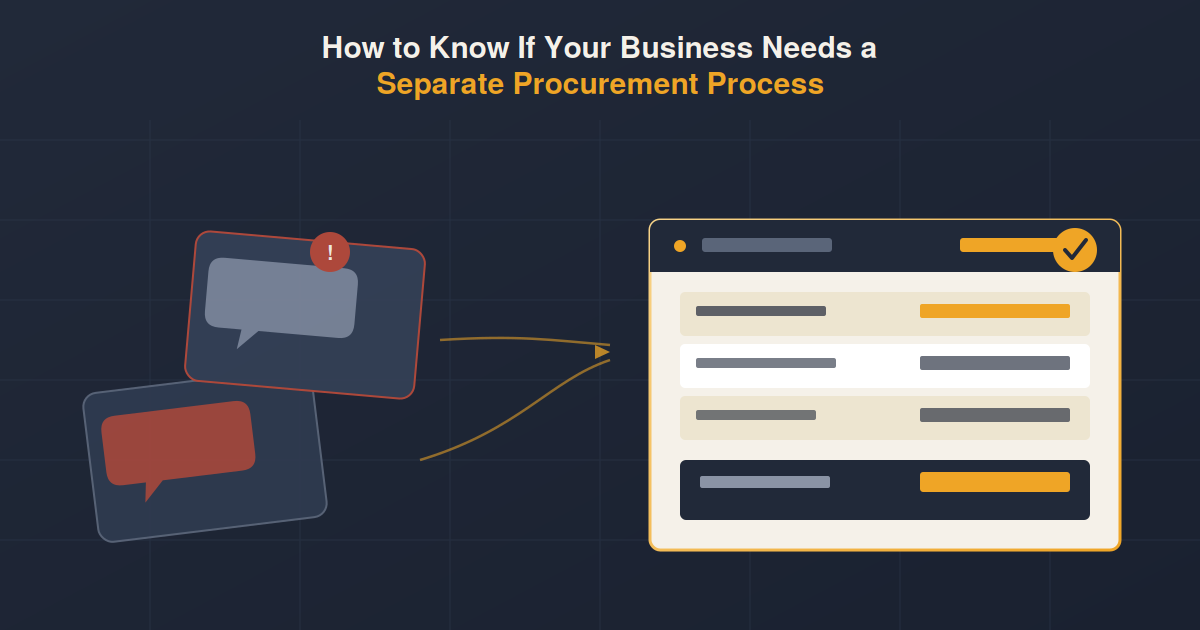
Most businesses do not plan their purchasing process. It just forms on its own, out of habit, until it starts causing problems nobody planned for either.
Ask most small business owners how purchasing works and the answer is usually some version of “whoever needs something just orders it.” Someone calls a vendor, someone else confirms the price over WhatsApp, and the item shows up a few days later. Nobody wrote this process down because nobody had to. It worked.
The question is not whether that worked when the business was smaller. It is whether it still works now. Purchasing tends to stay informal long after a business has actually outgrown informal purchasing, mostly because nothing forces the conversation. There is no single moment where it obviously breaks. It just gets slowly more expensive, more confusing, and harder to trace.
This is a practical look at how to tell the difference, what a separate procurement process actually solves, and what it looks like once you have one.
What “Procurement Process” Actually Means Beyond Just Buying Things
Every business buys things. That alone does not mean a business has a procurement process. A procurement process is the structure around buying, who can request a purchase, who approves it, how the vendor is chosen, how the order is tracked, and how the payment gets matched back to what was actually delivered.
Without that structure, purchasing still happens, it just happens differently every time, depending on who is doing it and how much attention they are paying that day.
How Purchasing Usually Starts: Informal and Ad Hoc
In the early stage of a business, informal purchasing is not a mistake, it is the right call. A founder or a single ops person knows every vendor personally, remembers rough pricing from memory, and can catch a bad order just by noticing something looks off. There is no real need for a formal system when the entire purchasing function fits inside one person’s head.
The problem is that this setup does not scale gracefully. It scales until it suddenly does not, usually right around the point where more than one person is placing orders, or the business is buying from more than a handful of vendors regularly.
Signs Your Purchasing Has Outgrown Informal Methods
A few patterns tend to show up right before a business realizes it needs a real process. None of them look dramatic on their own, which is part of why they get ignored for so long.
- More than one person is authorized to place orders, without a shared record of what has already been ordered
- Vendor pricing is remembered rather than recorded, so the same item gets bought at different prices depending on who negotiated it
- Orders get placed twice because two people did not know the other had already handled it
- Invoices arrive that do not clearly match any purchase order, so someone has to manually figure out what they were for
- Nobody can quickly answer how much has been spent with a specific vendor this quarter
The Real Cost of Verbal Orders and WhatsApp Confirmations
Verbal orders and chat confirmations feel fast, and in the moment they are. The cost shows up later, when there is a dispute about pricing, delivery timing, or whether an order was even placed. Without a written purchase order, the business has no real record to point to, only someone’s memory of a conversation.
This also makes vendors harder to hold accountable. A vendor who knows an order exists only as a chat message has less reason to honor agreed pricing or delivery terms than one working against a formal purchase order with clear terms attached.
A quick way to test this. Pick any vendor your business ordered from twice last month. Ask two different staff members what price was agreed both times. If the answers do not match, or nobody is fully sure, that is the informal purchasing gap showing itself.
No Vendor Records: Why That Becomes a Problem
When vendor information lives in someone’s phone contacts and a few old invoices, the business has no real visibility into who it buys from, what terms were agreed, or how reliable each vendor actually is over time. This becomes a bigger problem the moment that one person is unavailable, whether they are on leave, have left the company, or are simply busy with something else.
A structured procurement process keeps vendor details, contract terms, and payment history in one place that anyone authorized can access, not just the one person who happens to remember it.
Duplicate Orders and Duplicate Payments
This is one of the most common and most expensive symptoms of informal purchasing. Two people place the same order because there was no shared system showing what had already been requested. Or a vendor gets paid twice because the invoice was processed by two different people who did not know the other had already handled it.
These mistakes rarely get caught immediately. They usually surface weeks later, during a reconciliation, by which point recovering the money or correcting the order is a much bigger task than it should have been.
Missing Purchase History When Negotiating With Vendors
Negotiating leverage comes from knowing your own numbers. If a business cannot pull up exactly how much it has spent with a vendor over the past year, or how pricing has changed over time, it walks into every renewal or renegotiation at a disadvantage. Vendors keep their own records. A business without equivalent records is negotiating from memory against someone negotiating from data.
Budget Overruns You Don’t See Coming
Without a process that tracks committed spend, not just spend that has already happened, budget overruns are often invisible until the money is already gone. A department might place several orders that individually look reasonable, but collectively blow past what was budgeted, and nobody notices until the numbers are reconciled at month end.
A real procurement process tracks purchase orders as commitments the moment they are raised, not just as expenses once they are paid, which gives a business a live view of what it has already committed to spend.
Approval Bottlenecks, or No Approvals At All
Some businesses swing to the opposite extreme, every purchase, no matter how small, needs the owner’s personal sign off, which creates delays and makes the owner a bottleneck for routine decisions. Others have no approval step at all, which opens the door to unnecessary or even inappropriate spending going unnoticed.
A structured process sets sensible thresholds, routine purchases move quickly, larger or unusual ones get a proper review, without either extreme.
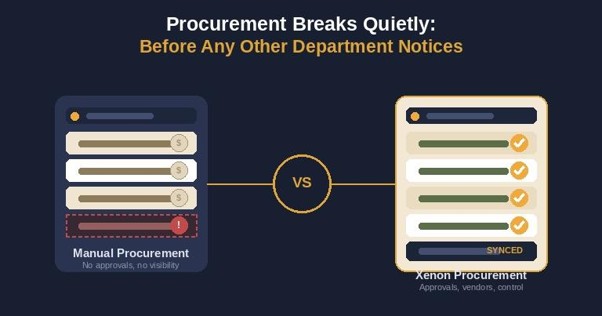
Xenon ERP’s Procurement module has helped businesses move from informal, person dependent buying into a structured process with clear vendor records, purchase orders, and approval tracking, without slowing purchasing down.
What a Structured Procurement Process Actually Looks Like
A structured procurement process does not mean more paperwork for its own sake. It means every purchase follows a consistent, traceable path. A request is raised, it is matched against a vendor with known terms, a purchase order is issued, the order is tracked until delivery, and the invoice is checked against the purchase order before payment goes out. Each step leaves a record, so nothing depends on one person’s memory.
Self Check: Do You Need a Separate Procurement Process
Quick Self Check
More than one person places purchase orders without a shared record
Vendor pricing has been inconsistent between orders in the last few months
An order has been placed twice by mistake in the past yearInvoices sometimes arrive that are hard to match to a specific order
Nobody can quickly say how much was spent with a given vendor this quarter
Purchasing decisions rely heavily on one person’s memory or availability
If you checked three or more, informal purchasing is likely already costing you more than it looks like day to day.
Informal Purchasing vs Structured Procurement
| Area | Informal Purchasing | Xenon Procurement |
|---|---|---|
| Vendor records | Held in contacts and memory | Centralized vendor list with contract and payment terms |
| Purchase orders | Verbal or chat based, no fixed record | Formal purchase orders with full order details |
| Spend visibility | Known only after reconciliation | Real time view of spent, outstanding, and available balance per vendor |
| Invoice matching | Manually cross checked, if at all | Invoices settled against tracked purchase orders and balances |
| Currency and import handling | Managed manually for foreign vendors | Multiple currency support built into the module |
| Finance integration | Separate from accounting records | Integrated with Finance and Accounting, including bank reconciliation |
Not sure how much informal purchasing is actually costing your business?
Xenon’s team can walk through your current buying process and show you where the gaps are.
Get a Free Procurement Review
What Xenon’s Procurement Module Actually Covers
Xenon ERP’s Procurement module centralizes vendor management and purchasing into a single system, connected directly to Finance and Accounting so nothing has to be manually reconciled after the fact.
Vendor Management
Maintain vendor contact details, contract terms, and payment terms in one place.
Purchase Orders
Define purchase orders formally, with full visibility into what has been ordered.
Balance Tracking
Check remaining balances and settle bills as payments are made, without manual cross checking.
Finance Integration
Connected directly to Finance and Accounting, including bank reconciliation for procurement accounts.
Multi Currency Support
Handle vendors and purchase orders in multiple currencies for import and export purchasing.
Spend Reporting
Run reports on spent amount against outstanding balance and available budget.
See the full breakdown on the Procurement module page.
How Procurement Connects to Finance and Inventory
Procurement does not operate in isolation. A purchase order eventually becomes a bill in the finance ledger, and if the item being purchased is stock, it also affects inventory the moment it is received. When procurement is disconnected from these other functions, someone has to manually update finance and inventory every time a purchase happens, which is exactly where information gets lost or delayed.
A connected procurement process means a purchase order flows naturally into the right financial record and the right inventory update, without a separate manual step in between.
What Setting Up a Procurement Process Actually Involves
Moving from informal buying to a structured process usually starts with getting existing vendor information into one place, current contacts, agreed pricing, and payment terms. From there, purchase approval thresholds are defined, so routine purchases move quickly and larger ones get proper review. The system is then connected to finance so invoices and payments settle automatically against the right purchase orders. Businesses that do this in stages, starting with their highest volume vendors, tend to see the benefit faster than those trying to formalize everything at once.
Frequently Asked Questions
At what size does a business actually need a formal procurement process?
There is no fixed size threshold. The clearer signal is when more than one person is placing orders without a shared record, or when vendor pricing and spend become hard to track consistently.
Will a procurement process slow down purchasing?
Not if it is set up with sensible approval thresholds. Routine purchases can move quickly, while only larger or unusual purchases require additional review.
Can Xenon’s Procurement module handle vendors we import from outside Pakistan?
Yes. The module supports multiple currencies, which makes it suitable for both domestic and international vendor purchasing.
How does procurement connect to our existing accounting setup?
Xenon’s Procurement module integrates directly with the Finance and Accounting application, including bank reconciliation for procurement related accounts.
Do we need to formalize every vendor relationship right away?
No. Most businesses start with their highest volume or highest risk vendors first, then expand the process to others over time.
What happens to our existing vendor and pricing history?
Existing vendor details and pricing history can be brought into the system as part of setup, so the business is not starting its records from zero.
Does a procurement process help with budgeting, not just purchasing?
Yes. Because purchase orders are tracked as commitments as soon as they are raised, the business gets a clearer, more current view of what has already been committed against budget.
Final Thoughts
Informal purchasing is not a mistake, it is usually the right way to start. The mistake is not noticing when it stops being enough. Duplicate orders, inconsistent vendor pricing, and invoices nobody can trace back to a purchase order are not random bad luck, they are what happens when purchasing outgrows the system it is running on.
If several of the signs in this article sound familiar, that is usually enough of a signal on its own. The business does not need to wait for a bigger, more painful mistake to justify making the process formal.
Related Reading
- Finance & Accounting Module Overview
- 9 Questions to Ask Before You Automate Payroll
- ERP Software Cost in Pakistan: Complete 2026 Breakdown for SMEs
Ready to see what a structured procurement process would look like for your business?
Book a free demo and walk through your own vendor and purchasing setup on Xenon ERP.
Book a Free Demo