
What if your sales team, warehouse, finance department, and HR could all operate from the same live data, without a single manual handoff? That’s not a vision of the future. It’s what modern ERP delivers today. Here’s why it matters more than ever.
The Problem
The Department Disconnect That Costs You Every Day
Walk through almost any growing business and you’ll find the same scene: each department running on its own tools, its own files, its own logic. Sales tracks leads in a spreadsheet. Finance lives in a standalone accounting app. HR manages payroll in a separate system. Warehouse staff update stock in yet another platform, or worse, a shared WhatsApp group.
Every department thinks it’s being efficient. But the business as a whole is hemorrhaging time and accuracy in the gaps between them. Data entered in one place has to be manually re-entered somewhere else. Reports require someone to collect information from five different sources. Decisions get made on outdated snapshots rather than live reality.
The core issue isn’t that your individual tools are bad, it’s that they were never designed to work together. And a business running on disconnected parts can never move as fast, or as accurately, as one running on a single unified system.
This is precisely the problem that Enterprise Resource Planning (ERP) was built to solve. And in 2025, all-in-one ERP platforms have become accessible, cloud-native, and purpose-built even for small and mid-sized businesses, not just the Fortune 500.
What Is It
What “All-in-One ERP” Actually Means
The term ERP gets thrown around a lot, so let’s be precise. An all-in-one ERP is a single software platform that manages all core business functions, sales, purchasing, inventory, manufacturing, finance, HR, customer service, from one unified database.
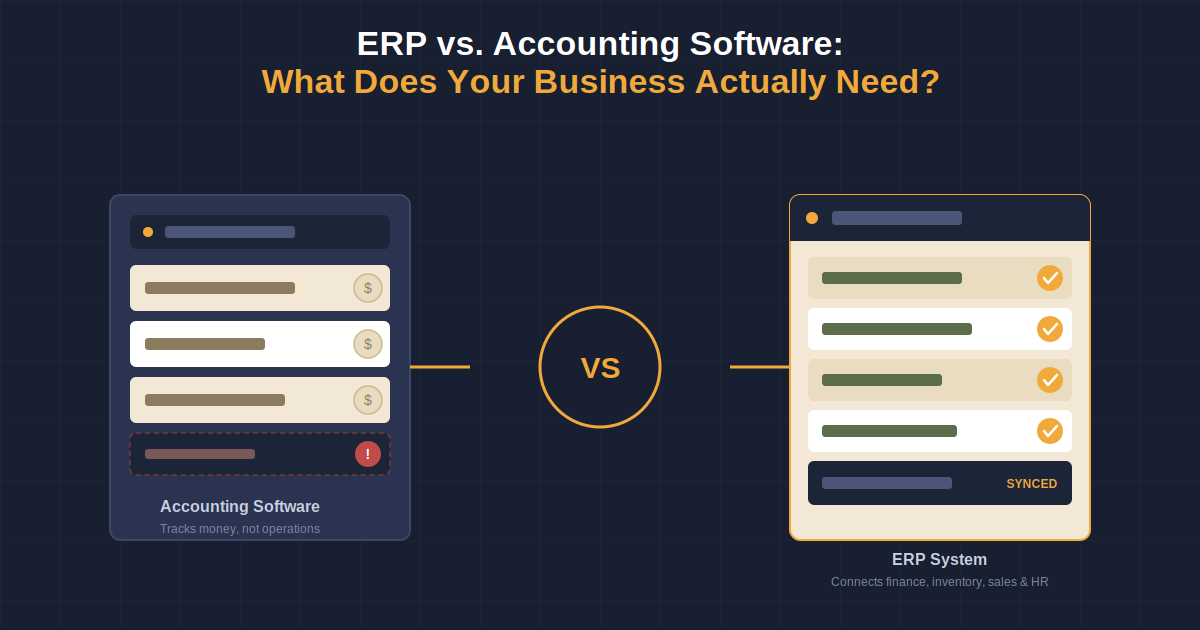
Unlike a stack of integrated apps (where you connect separate tools via APIs and hope they stay in sync), a true all-in-one ERP means every department works from the same real-time data. When a sale is recorded, inventory updates instantly. When an invoice is raised, it flows directly into accounts. When a new hire is added, payroll is automatically informed.
Think of it this way: Your business is a body. Right now, each department is an organ that only talks to the others through messengers, phone calls, emails, spreadsheet updates. An all-in-one ERP is the nervous system. Every part knows what every other part is doing, in real time, without anyone having to carry the message.
95% of businesses report improved processes after ERP adoption
36% average reduction in operational costs post-ERP
2.5× faster financial close with integrated ERP vs manual systems
40% improvement in reporting accuracy on average
Department by Department
How One Platform Transforms Every Department
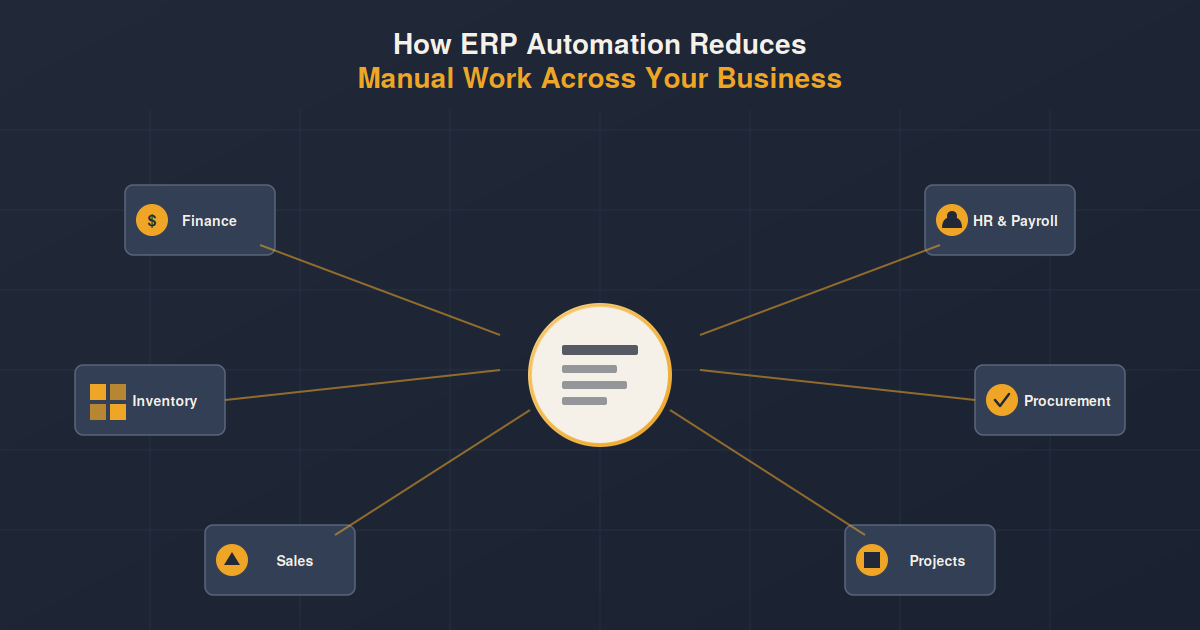
The power of all-in-one ERP isn’t abstract, it’s concrete, department by department. Here’s what changes when every team operates from the same system:
Sales & CRM
Full customer history, live inventory availability, and automated quote-to-order, all from one screen. No more chasing colleagues for stock updates.
Inventory & Warehouse
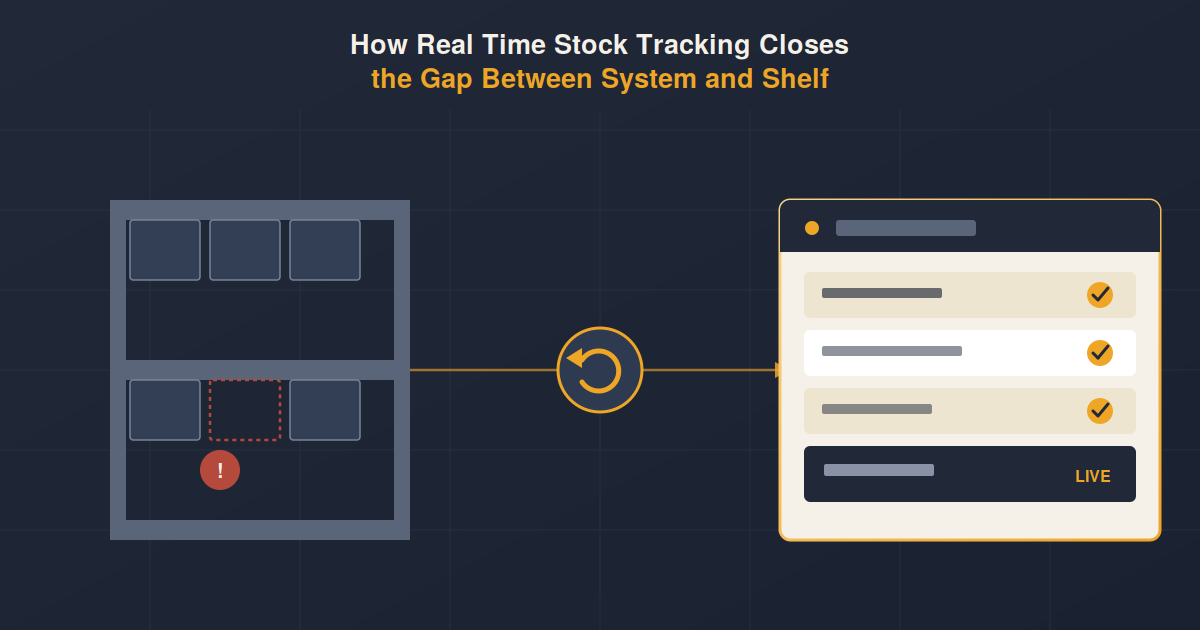
Real-time stock levels visible to every department. Automatic reorder triggers. Zero discrepancy between what’s sold and what’s in stock.
Finance & Accounting
Invoices, expenses, and reconciliations flow automatically from operations. Month-end close in hours, not days. Audit-ready at all times.
HR & Payroll
Employee records, attendance, leave, and payroll in one place. Compliance automated. HR freed from admin to focus on people.
Manufacturing & Production
Production orders linked to sales and inventory. Material requirements planned automatically. No more production halts due to missing stock.
Management & Reporting
Live dashboards across every KPI. No more waiting for weekly reports. Decisions made on real data, not last Tuesday’s spreadsheet.
According to Forrester Research, companies that deploy integrated ERP see an average ROI of 250% over three years, largely driven by time saved on manual processes and improved decision-making speed.
The Comparison
All-in-One ERP vs. Stacked Point Solutions
Many businesses believe they can achieve the same result by connecting multiple best-of-breed tools, a CRM here, an accounting app there, a HR tool on top. In theory it sounds logical. In practice, it creates a new layer of complexity and fragility.
| Capability | All-in-One ERP | Stacked Point Tools |
|---|---|---|
| Single source of truth | ✓ Always | ✗ Rarely |
| Real-time data across departments | ✓ Native | ✗ Requires syncing |
| Maintenance overhead | ✓ One vendor | ✗ Multiple vendors |
| Staff training burden | ✓ One system to learn | ✗ 5–10 different tools |
| Data security & compliance | ✓ Centralised controls | ✗ Scattered permissions |
| Scalability | ✓ Add modules as needed | ✗ Add new tools, new costs |
| Total cost of ownership | ✓ Lower long-term | ✗ Compounds with growth |
The hidden cost of managing integrations between disconnected tools, troubleshooting broken syncs, maintaining API connections, training staff on multiple UIs, often exceeds the perceived savings of sticking with cheaper point solutions. As Harvard Business Review notes, digital transformation fails most often not because of the technology chosen, but because businesses underestimate the complexity of the system they’re replacing.
The Resistance
The Objections — And Why They Don’t Hold Up
Every business considering ERP has doubts. Here are the most common ones, and the honest answers:
“It’s too expensive for our size.”
Modern cloud ERP platforms like Odoo start at a fraction of what legacy systems once cost, with per-user pricing that scales with you. The more relevant question is: what is your current setup costing you in lost hours, errors, and missed revenue?
“Implementation will disrupt everything.”
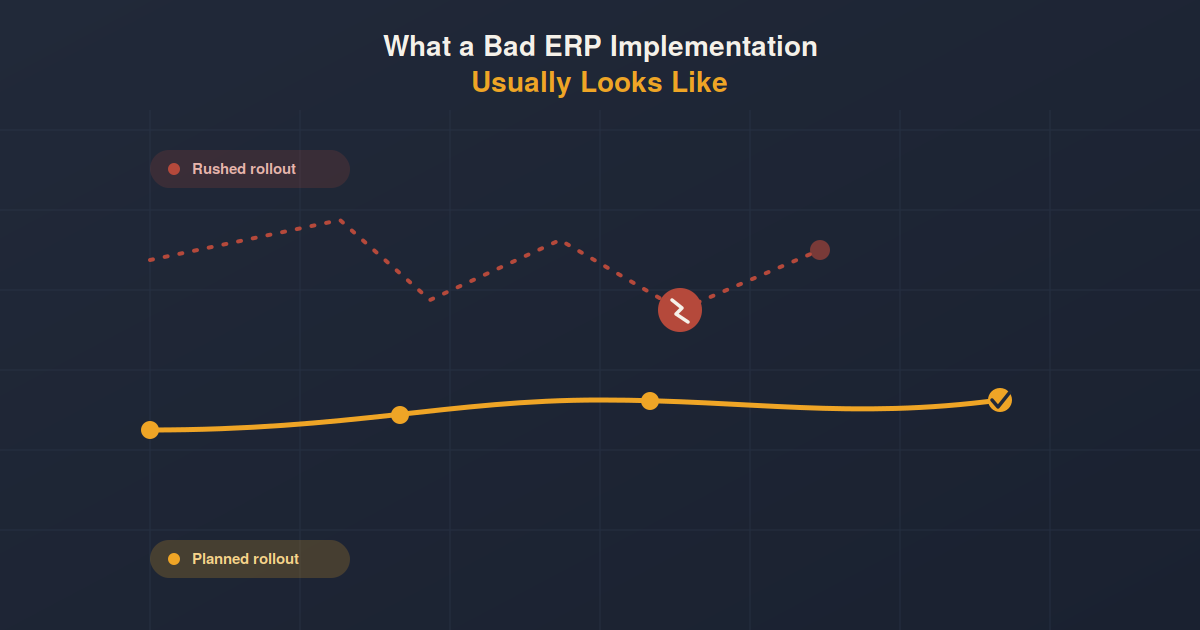
A well-planned ERP rollout, done in phases, with proper change management, causes far less disruption than the ongoing daily chaos of fragmented systems. The businesses that avoid implementation pain are often the ones that stay stuck longest. At Xenon, we design implementations around your real workflows, not textbook templates.
“Our team won’t adapt.”
One system, consistently used, is always easier to learn than five separate tools with five separate logins. Staff adaptation is quicker than expected when the system genuinely makes their job easier, and a good ERP does exactly that.
“We’re not ready yet.”
The businesses that implement ERP before they feel ready are the ones that scale smoothly. Waiting until you’re overwhelmed means you’re implementing under pressure, with messy data and fractured processes, the worst possible conditions.
The right time to build solid systems is always earlier than it feels comfortable. Growth exposes every weakness in your foundation. Build the foundation before the growth arrives, not after it breaks you.
What to Look For
What Makes a Good All-in-One ERP? 7 Non-Negotiables
Not all ERP platforms are equal. Whether you’re evaluating SAP, Odoo, Zoho One, or a custom-built solution, here’s what should be non-negotiable:
- Truly unified database — not just connected apps, but one system where all data lives together natively
- Real-time reporting — dashboards that reflect live data, not nightly syncs or manual exports
- Role-based access — every team member sees what they need, nothing more, with full audit trails
- Mobile accessibility — field teams, managers on the move, and remote staff need full functionality on any device
- Localisation — tax compliance, currency, language, and regulatory requirements for your specific market
- Scalable architecture — add users, locations, and modules without needing to migrate to a new system
- Implementation support — a partner who understands your industry and configures the system around your actual workflows
Local Context
Why This Matters Especially for Businesses in Pakistan
For Pakistani businesses navigating rapid growth, the operational challenge is acute. Many SMEs have scaled from small family operations to significant enterprises, but their systems haven’t kept pace. The result is businesses generating real revenue while still running on WhatsApp, Excel, and informal processes that create constant fire-fighting.
Add to this the complexity of FBR compliance, multi-currency trading, multi-city operations, and a workforce that spans field teams and office staff and the need for a unified system becomes not just a growth enabler, but a business continuity requirement.
Xenon’s ERP implementations are built specifically for this context, localised for Pakistan’s regulatory environment, configured for the industries we serve, and designed to be adopted by teams at every level of digital literacy.
The businesses winning in Pakistan’s market right now aren’t necessarily the ones with the biggest budgets, they’re the ones that moved fastest to build operational clarity. A unified platform is the single biggest lever available to most SMEs today.
Getting Started
How to Begin: A Practical Starting Point
If you’re convinced but unsure where to start, here’s a practical framework:
- Audit your current tools: List every platform, app, and spreadsheet your team uses. Map where data lives and where it has to be manually moved between systems.
- Identify your biggest pain points: Where do errors happen most? Where does the most time get lost? Where does miscommunication cause the most damage?
- Define your must-haves: Which departments need to be in scope from day one? What integrations are non-negotiable?
- Choose a platform and partner: The technology matters less than the implementation. A well-implemented mid-tier ERP will outperform a poorly-implemented premium one every time.
- Plan for change management: Budget time and attention for training and adoption, this is where most ERP projects succeed or fail.
If you’d like an expert perspective on which platform and approach makes most sense for your specific business, the team at Xenon is available for a no-obligation consultation. We’ve helped businesses across retail, distribution, manufacturing, and services make this transition and we know where the traps are.
Your Business Deserves
One Source of Truth.
Xenon helps growing businesses across Pakistan implement all-in-one ERP systems that connect every department, eliminate manual work, and build the operational foundation for real scale.